
For Josh Podvin, connection starts with listening and grows through trust, persistence, and presence.
As assistant director for community partnerships in the University of Georgia’s Office of Service-Learning, Podvin helps bridge the campus and the community by creating spaces where students, faculty and local residents collaborate to address real-world challenges.
“I always tell folks I’d do this work in my free time,” he says. “It’s what I really care about—helping communities thrive by bringing people together in meaningful ways.”
Podvin’s path to community engagement wasn’t straightforward. As an undergraduate at a small liberal arts college in Ohio, he majored in German and threw himself into campus life, joining environmental groups and performing in theater. But more than any major or activity, what shaped him most was the experience of getting involved.
After graduation, Podvin worked at his alma mater before pursuing a master’s degree in higher education administration at Arizona State University. There, his work with student organizations deepened his interest in student engagement and eventually led him to UGA, just as the university launched its Center for Student Organizations. Podvin spent nearly a decade in Student Affairs, but a service-learning course in UGA’s Landscape Architecture program became a turning point.

“That course changed everything,” he recalls. “You had to listen to what a community needed and then design something in response. That model—working alongside people rather than for them—resonated with me deeply.”
In 2016, Podvin transitioned to the Office of Service-Learning (OSL). Today, he connects university programs with local organizations in Athens and across northeast Georgia. He oversees OSL programs that work with the Clarke County School District including Experience UGA and Coaching4Success program, and helps coordinate nonprofit trainings in partnership with United Way and the Athens Area Community Foundation.
“If service-learning is a coin, the faculty and student side is one half, and the community is the other,” he explains. “My job is to listen, understand local needs and build connections that benefit everyone involved.”
Podvin also leads the Public Service and Outreach Student Scholars program, a yearlong initiative that introduces exceptional students to UGA’s statewide public service mission.
“These students are brilliant,” he says. “Many have already benefited from PSO work in their hometowns whether they realize it or not. This program helps them connect the dots and see how they can be part of that work moving forward.”
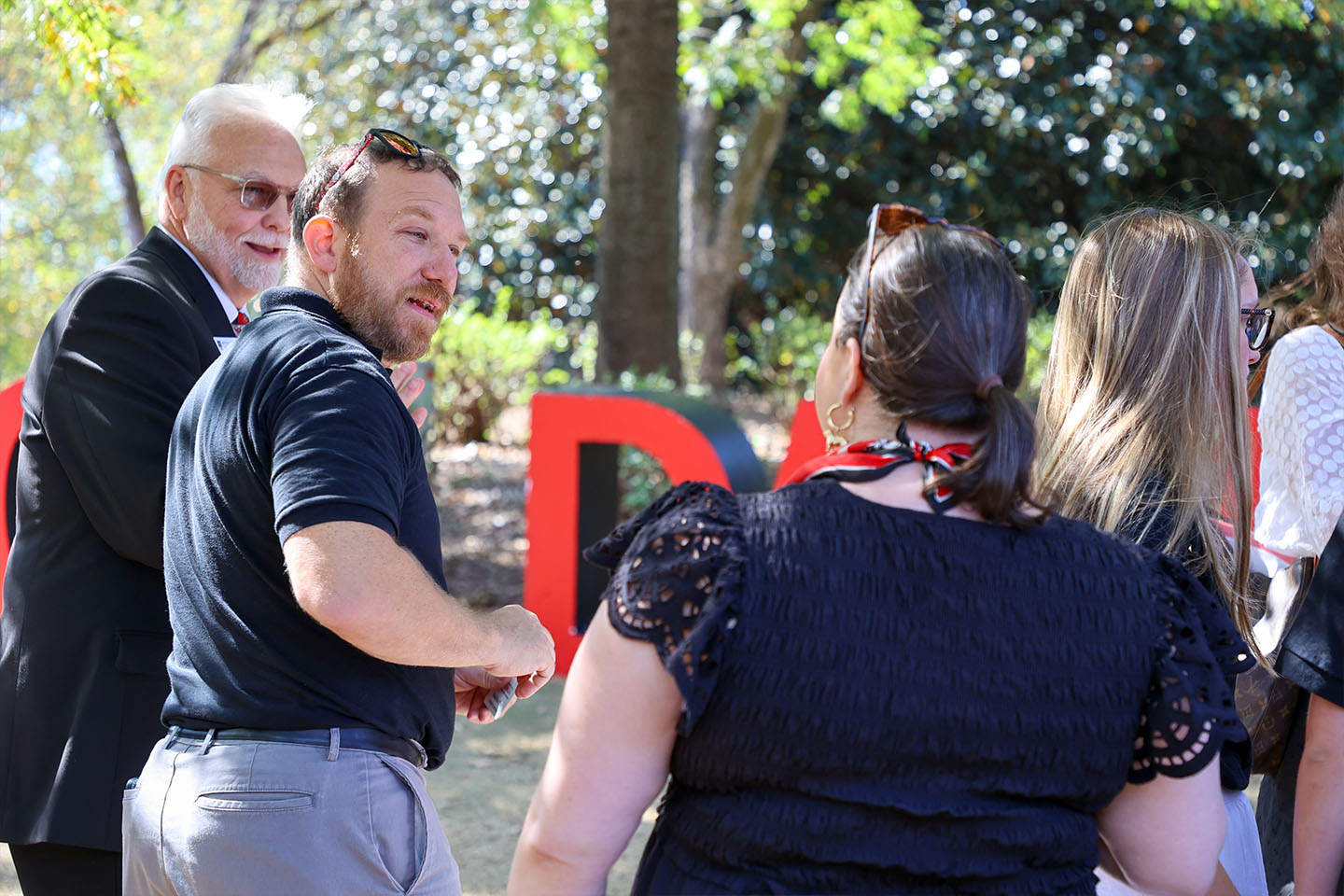
Podvin’s commitment to community goes far beyond his job description. He and his wife, Erin, are deeply rooted in Athens, often volunteering together and emceeing events for local nonprofits.
“Our first date was a fundraiser,” he laughs. “Most of our date nights still are.”
Podvin is quick to acknowledge the complexities of community partnership work, especially the need to build trust.
“History lives in our relationships,” he says. “The only way forward is to keep showing up and keep listening. Over time, people can tell when your motives are genuine.”
That commitment made a tangible impact during the COVID-19 pandemic. Podvin helped mobilize UGA’s Engage Georgia platform to connect community members with essential resources—food, services and support—when they were most needed.
“Being able to take a university tool and apply it for public good—that’s powerful,” he says. “That’s what this work is all about.”
Looking ahead, Podvin hopes to see students graduate with a deeper understanding of what it means to be engaged members of any community.

“Community engagement looks different everywhere,” he says. “But the habits of reflection, empathy and presence are what makes the difference. If we can help students develop that before they leave UGA, we’ve done something meaningful.”
His advice to students? Start simple.
“Just get involved. Show up. Don’t let the unfamiliar stop you,” he says. “Whether it’s volunteering, pottery, or soccer—find your people and begin. Everything else will follow.”
For Podvin, this work is more than a profession. It’s a mindset and a mission. “We all care about the places we live,” he says. “The real question is: How are we showing up for them?”